Best matches
20 results-
Shoftim 5757Volume 19 · Issue 1
Origins of the Shofar
He then cites Rav Hai Gaon. “It is customary to recite supplications only during the Ten Days of Repentance. But I heard that in some places, the custom is to rise early from Rosh Chodesh Elul and on because Moshe Rabbeinu ascended the Mountain for the third time and remained there, descending on Yom Kippur with the Second Tablets
-
Beshalach 5758Volume 19 · Issue 18
Spoils of War
The Rambam (Hilchos Teshuvah 9:1) explains with great elaboration to ingrain the concept in our hearts that none of this has to do with reward and punishment. Instead, it is a promise that when we do what is good and just
-
Bechukosai 5765Volume 1 · Issue 12
Shavuos: Festival of Weeks
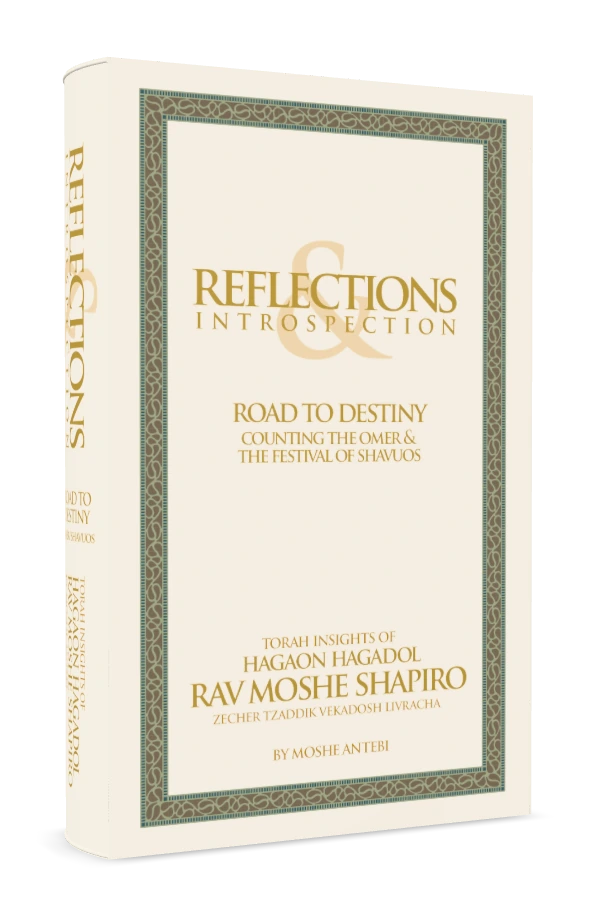
Our rabbis warned us most strongly that the judgment of the days of the Omer and Shavuos are more significant than the days of judgment of Rosh Hashanah, the Ten Days of Repentance, and Yom Kippur. During the Omer and Shavuos, the judgment concerns eternity, and one who allows the opportunity to lapse and does not live within its unique timeframe loses his connection to the Tree of Life
-
Yisro 5765Volume 1 · Issue 3
The Principle of Redemption
This includes all corollaries of killing. Humiliation also drains the blood from the face and gives it the pallor of death (Bava Metzia 58b; cf. Gates of Repentance 3:140).
-
VaYikra-Zachor 5760Volume 20 · Issue 26
United Against Excess
The Maharal finds this hinted in the Hebrew alphabet (Derush LeShabbos Teshuvah 72b). Ten is the minimal amount of people for communal oneness, for nationhood. This is represented by the first ten letters, from Aleph to Yud.
-
Shemini-HaChodesh 5760Volume 20 · Issue 28
Time of Freedom
The Rambam and other earlier commentators often use the expression ‘vapors of time,’ as in (Hilchos Teshuvah 3:4), “Those who forget the truth due to the vapors of time” (cf. Hilchos Mezuzah 6:13).
-
Ki Savo 5759Volume 20 · Issue 3
Blessings and Reward
The Rambam finds the curses as well as the blessings difficult to comprehend altogether, and he elaborates on the question and answer (Hilchos Teshuvah 9:1). He begins by saying that as all know, the reward for keeping the mitzvos is the Eternal Life of the World to Come and the punishment for abandoning the mitzvos is being cut off from Eternal Life.
-
Behaaloscha 5760Volume 20 · Issue 33
Fearsome Journey
praises the Creator as the Holy King throughout the year may have not fulfilled the obligation of prayer. The Creator is certainly the Holy King. Only, this attribute is not revealed other than during the Ten Days of Repentance.
-
Noach 5760Volume 20 · Issue 7
Endless Achievement
hovering over the face of the waters. This refers to the spirit of the Messianic King, upon whom the spirit of God will alight (Yeshayahu 11:2). In what merit does his spirit approach? It is in merit of repentance, which is compared to water, as it says, “Pour out your heart like water…” (Eichah 2:19).
-
Miketz Chanukah 5761Volume 21 · Issue 14
My Dove
…dove, Yonah, “Another forty days, and Nineveh shall be overturned,” and it indeed overturned—with repentance (Yonah 3:4; Rashi
-
Ki Seitzei 5760Volume 21 · Issue 2
Wisdom Not Work
power is great even against the Angel of Death. It alleviates the level of death that relates to us on a daily basis—it awakens those who are asleep, and sleep is one sixtieth of death (Rambam, Hilchos Teshuvah 3:4; Berachos 57b).
-
Ki Sisa-Parah 5761Volume 21 · Issue 23
New Heaven New Earth
This underlies the odd wording of the following passage as I understood from the Maharal—part he says openly, and part, he only intimates (Derush LeShabbos Teshuvah 74a).
-
Tazria-Metzora 5761Volume 21 · Issue 25
The Blessing of Nourishment
Land of Israel, which is often called the Lands of Life (Tehillim 116:9), God’s heritage (Shmuel I 26:19), and many similar names that reflect its parallel on earth to the World to Come (cf. Rambam, Hilchos Teshuvah 8:4).
-
Behar-Bechukosai 5761Volume 21 · Issue 28
Passionate Devotion
Torah of Truth, and He planted Eternal Life within us.” These plantings bear fruit. At times, they may be consumed in This World, but only as fruit. The principle remains intact for the World to Come (cf. Rambam, Hilchos Teshuvah 9:1).
-
Bamidbar 5761Volume 21 · Issue 29
Creation Redefined
The foregoing is essentially a translation of the Rambam in his answer to a question he poses (Hilchos Teshuvah 9:1).
-
Naso 5761Volume 21 · Issue 30
Between Man and His Fellow
obligating factor of these two types of mitzvos. The mitzvah itself is the same. Only in mitzvos between man and his fellow, there is an additional impingement, as if it were accompanied by another sin. To rectify this wrong, repentance is not enough. One must also appease the person (Rambam Hilchos Teshuvah 2:10).
-
Behaaloscha 5761Volume 21 · Issue 31
Reduced to Words
The Rambam (Hilchos Teshuvah 8:2) explains the crowns on their heads as parabolic of the knowledge they amassed, which brought them there—knowledge in the sense of what it says, “So that you may know…” (Melachim I 8:60) “Know this day…” (Devarim
-
Shoftim 5761Volume 22 · Issue 1
Beyond Death
The Maharal discusses the topic toward the beginning of Derush LeShabbos Teshuvah (66b) and in Chiddushei Aggados to Avodah Zarah 4b (4:29b), 5a (4:31a), and introduces—or more accurately, alludes to—a novel point.
-
Beshalach 5762Volume 22 · Issue 17
Doorway to Heaven
This is precisely his wording by the shofar (Hilchos Teshuvah 3:4), “Although the sounding of the shofar on Rosh Hashanah is a Biblical decree, it bears an allusion, as if to say, ‘Awake from your sleep, you who sleep, and arise from your slumber, you who slumber. Search your
-
Nitzavim 5761Volume 22 · Issue 4
Exalted Exclusively
As we know, Rosh Hashanah is a beginning and Yom Kippur an end, and the entire span of time is a single unit. “These are the Ten Days of Repentance between Rosh Hashanah and Yom Kippur” (Rosh Hashanah 18a).